Blue Printing Press
Overview
1. The Problem
Traditional Service Blueprinting workshops are resource-intensive, requiring skilled facilitators for 2-4 hour sessions with quality varying by facilitator expertise. They're difficult to scale due to limited facilitator availability, manual note-taking often misses key insights, and post-session synthesis takes days—resulting in 8-16 hours total per blueprint.
2. The Solution
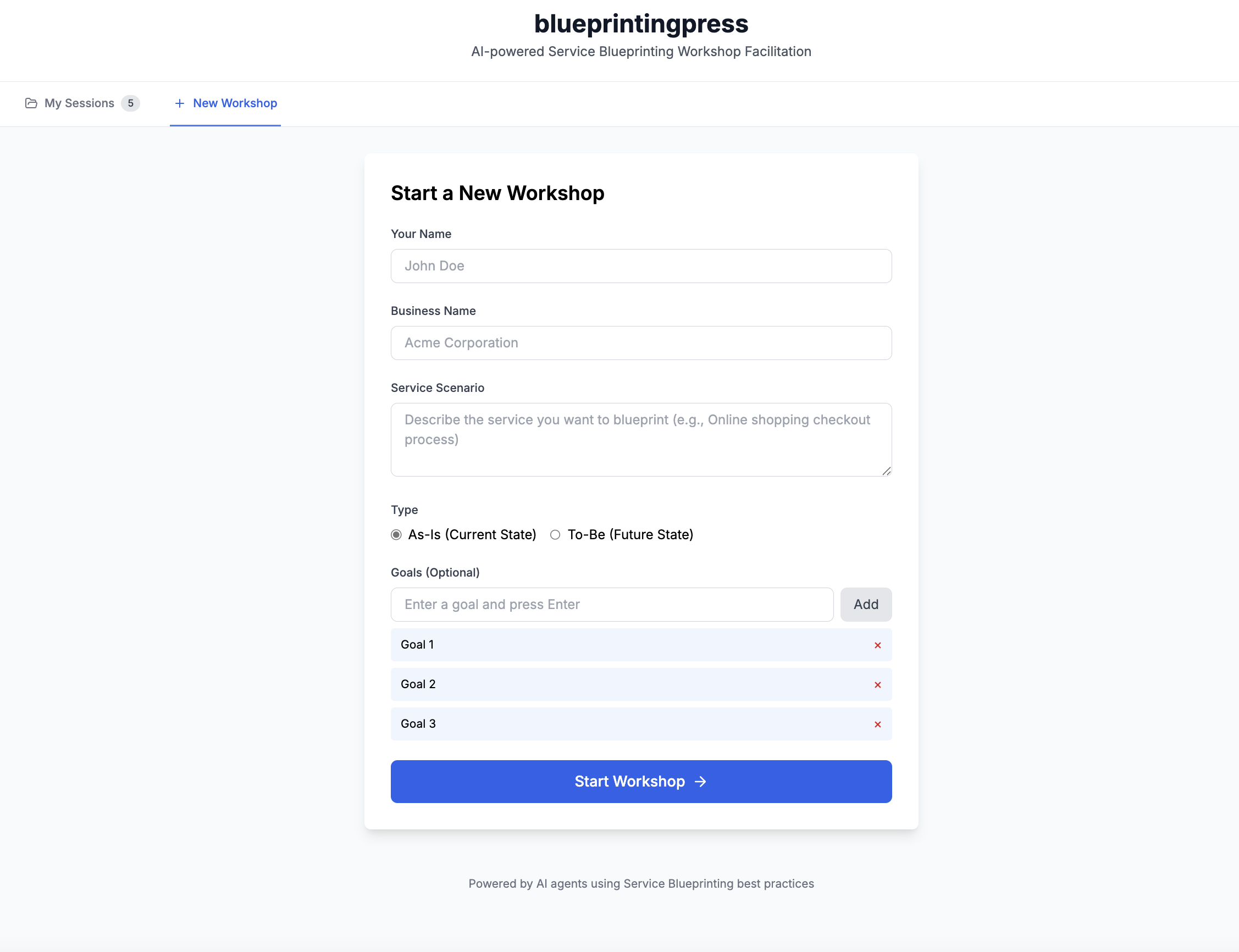
blueprinting.press is an AI-powered facilitation system that guides conversations using best-practice techniques, enforces the Service Blueprinting framework to maintain focus, captures everything in real-time structured format, generates artifacts automatically (live Mermaid diagrams + polished deliverables), and scales infinitely with consistent quality—reducing total time to 2-3 hours per blueprint.
3. Innovation and Features
4. Libraries and Frameworks
Design Process Summary
The design followed an API-first, multi-agent architecture approach. We started by defining clear user personas (service design facilitators and client stakeholders) and established success metrics targeting a 70% reduction in workshop time. The system was decomposed into specialized agents—each responsible for a distinct task (intent parsing, facilitation, domain expertise, validation)—coordinated through an orchestration layer with a well-defined state machine. RAG was integrated early to enable contextual facilitation using client documents. The frontend was designed around a workshop metaphor with real-time diagram feedback, while the backend prioritized scalability through Docker containerization and database abstraction (SQLite for MVP, PostgreSQL for production).